How Hyperspectral Imaging Is Reshaping Mining Safety
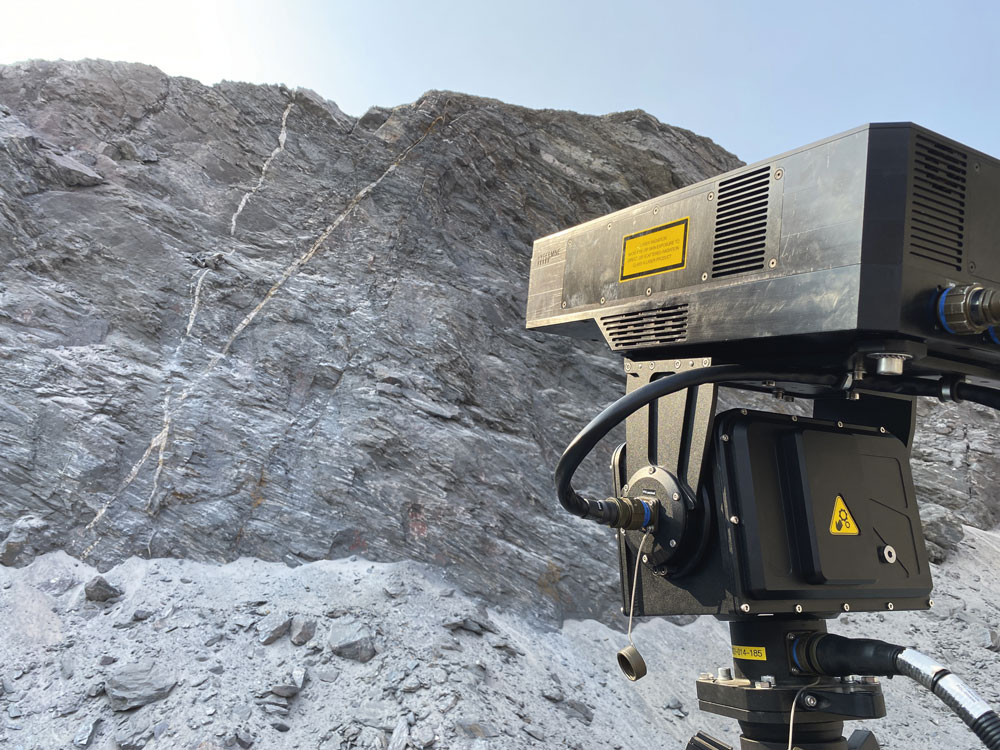
A laser-based hyperspectral scanner developed by Finnish scientists gives mining companies a faster and more precise way to identify mineral compositions, enabling the early-stage separation of valuable minerals directly at the point of extraction.
Hyperspectral mineral detection is one of the most promising alternatives to traditional mineral detection methods, as it enables real-time analysis of excavated rock and the separation of valuable ore even from rock considered as waste. This not only reduces material loss and optimises production but also supports maintenance efficiency and improves operational safety.
A 2023 study in the International Journal of Mining Science and Technology found that hyperspectral imaging offers greater accuracy and flexibility than traditional mineral detection, particularly for continuous, non-destructive measurements. Unlike laboratory-based methods that require physical samples, hyperspectral systems gather data remotely and instantly, enhancing mineral identification, process control, and maintenance planning.
Hypermine Global Ltd., the company behind the new laser-based system, reports that its technology can improve detection accuracy by up to a hundredfold, increase mine yields by 10%, while reducing energy and water use in production processes.
From research to global innovation
Hypermine Global originated at VTT, Finland’s leading research and technology centre, where hyperspectral technology has been developed since the 1960s. Over the years, VTT’s research has produced several successful spin-offs, including SPECIM, Spectral Imaging Oy Ltd., whose hyperspectral cameras are used today worldwide.
Mining remains a cornerstone of modern industry—essential for energy, electronics, and construction—but operations often take place in challenging environments. Hypermine Global was founded to address these challenges by applying hyperspectral technology to real mining conditions.
Initially used in laboratories, laser-based hyperspectral imaging evolved toward field applications through a co-development with a leading mining company led by Dr. Mikhail Mekhrengin and Dr. Andrei Rupasov.Early discussions with major mining companies revealed strong interest.
“We spoke with more than ten major mining firms worldwide, and over 95% wanted to pilot the solution immediately. That was a clear sign we were on the right path,” says Hypermine Global CEO Mikhail Mekhrengin..
More revenue, less waste
Global megatrends—urbanisation, population growth, and the energy transition—are increasing demand for minerals, even as easily accessible deposits decline.
“Currently, rocks are sorted in massive 10,000-ton mining blocks, which leads to unnecessary waste,” Mekhrengin explains.
“Our technology identifies good and poor boulders right after blasting, boosting yields while cutting energy, acid use, and water consumption by 10–15%.”
This precision also reduces wear and tear on mining equipment. By separating valuable fragments early, unnecessary handling is avoided, optimising system loads and extending machine life.
“At the same time, safety improves: when only selected materials are processed, equipment experiences less stress and fewer failures,” says Mekhrengin.
Remote analysis further enhances worker safety by eliminating the need for manual sampling in hazardous zones, reducing exposure to dust, chemicals, and collapse risks, Mekhrengin adds. Real-time data also improves maintenance predictability, allowing early detection of potential failures or safety threats.
How hyperspectral imaging works
Traditionally, run-of-mine (ROM) material selection depends on exploration phase sampling and laboratory testing — methods that are labour-intensive, time-consuming, and costly. Hyperspectral laser scanning provides a proven alternative, offering rapid and comprehensive data on the chemical composition and physical properties of mined materials.
By analysing subtle spectral variations, engineers can identify mineral types, trace elements, and quality indicators such as alumina or gypsum content. Scanners can be positioned throughout mining operations—on trucks, conveyors, or near drilling areas—to assess material composition in real time.
“The core of HyperMine™ technology is rapid, point-by-point mineral identification,” Mekhrengin explains. “A broadband laser targets the rock, and a hyperspectral sensor measures the reflected signal. Algorithms then determine the mineral composition. Each point is analysed separately, ensuring accuracy and repeatability regardless of lighting or weather.”
Results are delivered in under a minute, enabling deployment at various stages—from blasting to loading and transport.
The system has been piloted in the UK, South Africa, Brazil, and Canada. “The pilots taught us the optimal balance between detection speed and accuracy,” says Mekhrengin. “Having major players involved has validated our technology and built strong credibility in a tightly connected global industry.”
Safety, maintenance, and sustainability
“In mining, everything connects to safety. If maintenance fails, both people and production are at risk,” says Mekhrengin.
Traditional sampling often forces personnel into unstable or contaminated areas. Hyperspectral sensors eliminate this by allowing remote, non-contact material analysis. Integration with existing monitoring and fleet management systems is straightforward, ensuring seamless adoption without major infrastructure changes.
“Samples can be analysed safely from a distance. Integration with truck fleets and process systems is simple,” Mekhrengin adds.
Beyond operational gains, hyperspectral imaging supports sustainability. By optimising material flows and reducing waste, mines can lower their environmental footprint.
“Mining inevitably leaves a footprint, but optimising material flows through precise mineral identification helps reduce unnecessary processing. In some cases, the technology even enables reprocessing of old waste piles—turning discarded material into usable resources.”
AI and global growth
Hypermine Global aims to become a major international player, combining economic success with societal impact. Its first customer is already one of South America’s largest mines, with further implementations in progress.
“The potential market is enormous—worth €20–40 billion annually in benefits to customers,” says Mekhrengin. “Our goal is to grow to several hundred million euros in annual revenue.”
Artificial intelligence will play a growing role in the next decade.
“We’re already using machine learning to refine our systems,” Mekhrengin notes. “By combining AI with hyperspectral data, geologists and data scientists can unlock new applications. Once customers see how accurate and repeatable the measurements are, new ideas emerge.”
Real-time, data-driven decision-making could soon become the industry standard.
“Our goal isn’t to replace people,” Mekhrengin concludes, “but to give them tools to do their jobs better. This will be one of the most significant transformations in mining technology in the coming years.”
Hyperspectral imaging in maintenance
1. Less unnecessary load: More accurate separation of ore and waste rock reduces stress on equipment.
2. Safer working environment: Safe-distance analytics reduces the need for dangerous tasks.
3. Energy savings and lower environmental impact: Less waste material saves energy, chemicals, and water.
4. Better process control: Real-time data supports maintenance and process optimisation.
5. Longer mine life: Finer granularity selection of valuable materials, and optimising material flows extends mine life and enables the reuse of waste piles.
Text: NINA GARLO-MELKAS Photo: Hypermine Global