
Uncharted Territory: Only Accurate Detection Can Swing the Pendulum Away From Dangerous Extremes
Today’s world is increasingly polarised on almost every issue. From hugely important topics like the economy and foreign policy to ’first world problems’ like the casting of a particular TV show, it seems difficult to build a sizable consensus on almost anything.
Using data to inform the global conversation on climate change
Recent years have brought the consequences of climate change into sharp focus for millions of people across the world. In Africa, 1.6 million people have been displaced by climate-induced flooding[1], while the USA has been plagued by extreme weather resulting in an increased acreage of burned land along its West Coast[2]. In total, scientists have counted 504 extreme weather events that have occurred since the turn of the millennium[3]. Of these events, 71% were made more likely or more severe as a consequence of human-caused climate change – and only 49 of them occurred before 2011.
Our environment is a delicately balanced series of interconnected systems, and changing things can have unintended or unexpected side effects.
Put simply, many are realising they cannot ignore climate change anymore, as its results can be seen on their doorstep. The only questions surround what to do about it – and the answers to those questions are held by data. This means that all industries must do their bit to collect more data about their emissions – especially those industries most closely associated with large gas emissions, like oil and gas production, energy, and mining.
Improving data collection can drive real change. The data collected in recent years has given rise to a global focus on carbon that has penetrated mainstream consciousness. Now terms like ’carbon footprint’ are part of our everyday lexicon, and businesses look to differentiate themselves in the eyes of consumers by promoting the carbon costs of their products.
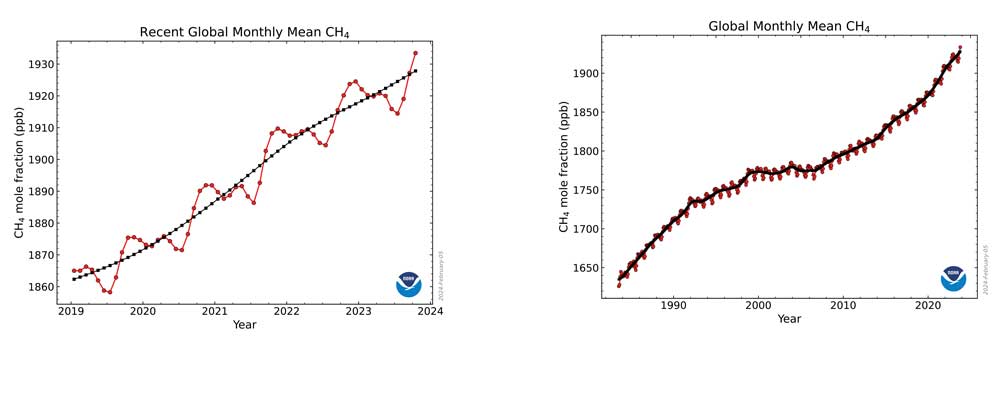
The graphs show globally-averaged, monthly mean atmospheric methane abundance determined from marine surface sites. The first graph shows monthly means for the last four years plus the current year, and the second graph shows the full NOAA time-series starting in 1983. Values for the last year are preliminary, pending recalibrations of standard gases and other quality control steps. Other impacts on the latest few months of data are described below. The Global Monitoring Division of NOAA’s Earth System Research Laboratory has measured methane since 1983 at a globally distributed network of air sampling sites (Dlugokencky et al., 1994). Source: Lan, X., K.W. Thoning, and E.J. Dlugokencky: Trends in globally-averaged CH4, N2O, and SF6 determined from NOAA Global Monitoring Laboratory measurements. Version 2024-02, doi.org/10.15138/P8XG-AA10
However, bringing down carbon emissions is very much a long-term project. The structure of carbon dioxide means each molecule has a relatively low heating potential on its own, but each one can persist in the atmosphere for hundreds of years. This means emissions are building up to have a significant cumulative effect on our climate – and that further changes are ’baked in’, as emissions from decades ago may not fully dissipate for centuries.
More worryingly, there is a much more pressing threat to our planet’s future that has gone largely under the radar until now – methane.
Building momentum on methane
Unlike carbon dioxide, methane molecules have a very high heating potential, which can be up to 86 times more potent than carbon dioxide when it first reaches the atmosphere. However, it also has a much shorter lifespan, and dissipates within around 20 years[4]. In other words, while methane emissions are accelerating our race towards the climate cliff edge, cutting them could pull us back from the brink just as quickly.
Act includes the creation of the Methane Emissions Reduction Program, which grants up to $350m to states to support businesses in identifying and cutting methane emissions[5]. The EU has proposed similar legislation, set to come into force imminently[6].
These new laws will influence the way many industries operate in the near future. As an example, one of the measures to be passed by the EU is a ban on flaring and venting by 2027. This will particularly impact the upstream oil and gas sector, where flaring and venting are still often used to dispose of excess gas.
And the EU’s law goes further still, forcing operators of fossil fuel infrastructure to measure and report emissions while regularly checking for emissions. This also applies to imports from non-EU countries, meaning importers must demonstrate that their supply chain works to the same or equivalent monitoring standards.
This is a microcosm of the complexities and challenges involved in fighting climate change. Our environment is a delicately balanced series of interconnected systems, and changing things can have unintended or unexpected side effects. As tightening legislation makes it more important for businesses to tackle their methane emissions, it remains crucial to build a complete picture of the world’s methane problem before taking the urgent action needed to address it – and building this picture is only possible with the right tools.
Infrared sensors powered by advanced optical coatings
Although large-scale monitoring operations often rely on satellite technology, technological advances mean that businesses today can employ a wide range of on-the-ground equipment that can help them begin building better-quality data on emissions. Leading the way in this technology are high-performance infrared sensors, which pass lasers through a filter inside a sampling chamber to measure the attenuation of incoming light and determine the precise concentrations of gas that are present.
The next-generation flexibility and sensitivity of gas sensing technology are largely driven by advances in electro-optical coatings. These coatings provide control over which wavelengths of light can reach the sensor. A sampling of the atmosphere is compared against a reference that enables a gas analysis system to monitor for discrepancies between the two. Each gas has a unique structure that absorbs different wavelengths of light in different amounts, providing a unique chemical fingerprint that sensors can use to identify the target gas.
As businesses move beyond estimations into a world of empirical measurement, a true revolution on methane is within reach.
Technology such as this is helping businesses fill in the picture on methane emissions and better focus their mitigation attempts. Combined with other methods, action on methane by the oil and gas sector today could cut human-caused emissions by as much as 45% within 10 years. If achieved, this would stop global temperatures from warming by almost 0.3°C by 2045[9], according to the Climate and Clean Air Coalition.
This may sound like a relatively insignificant amount, but it would represent 20% of progress towards the target of limiting global temperature rises to 1.5°C and would go a long way to helping achieve targets set out under the Paris Agreement.
Widespread adoption of gas detection technology will also vastly improve the data on harmful leaks available across other market sectors, such as engineering and manufacturing, while also facilitating preventative action. Investing in this equipment must therefore be central to any company’s business operations; only by understanding where harmful leaks are occurring can industrial facilities hope to offer their people the protection they deserve.
And the incentives for action here are not purely environmental. Gas leaks come with a significant cost, with billions of dollars’ worth of natural gas being wasted every year – potential profits that are literally vanishing into thin air. The indirect economic impact is even more significant. The Climate and Clean Air Coalition report referenced earlier also found that slowing global heating by reducing methane emissions would also result in 775,000 asthma-related hospital visits, 26 million tonnes of crop losses, and 73 billion lost work hours due to the effects of heat exposure. A more rigorous gas detection approach, supported by technology, could enable more gas to be captured and sold, and have a real impact on a business’s bottom line.
There remains much work to be done. Due to the way methane emissions persist in the atmosphere, the global picture may get worse before it gets better. While it may worsen, it will also become much clearer, giving the world a better idea of where and how emissions are produced, where leaks are occurring – and how they can be fixed.
Text: By Mark Naples, Managing Director at Umicore Coating Services Images: SHuTTERSTOCK, FREEPIK
[1] iea.org/reports/global-methane-tracker-2023
[2] energy.ec.europa.eu/topics/oil-gas-and-coal/methane-emissions_en
[3] theguardian.com/environment/2023/dec/02/us-outlines-measures-to-cut-methane-emissions-by-80-in-next-15-years
[4] theguardian.com/world/2023/may/09/mind-boggling-methane-emissions-from-turkmenistan-revealed